Top, Middle & Base Notes in Perfume Explained (+ Real Examples)
Have you ever sprayed a perfume and noticed that it smells one way in the first few minutes, then completely different an hour or two later?
That is one of the most interesting things about fragrance.
A perfume is not simply one smell that stays unchanged throughout the day. As it develops on your skin, different parts of its composition become more noticeable. The bright opening gradually settles, the heart of the fragrance becomes clearer, and eventually the deeper base shapes the dry down.
This is where top notes, middle notes, and base notes come in.
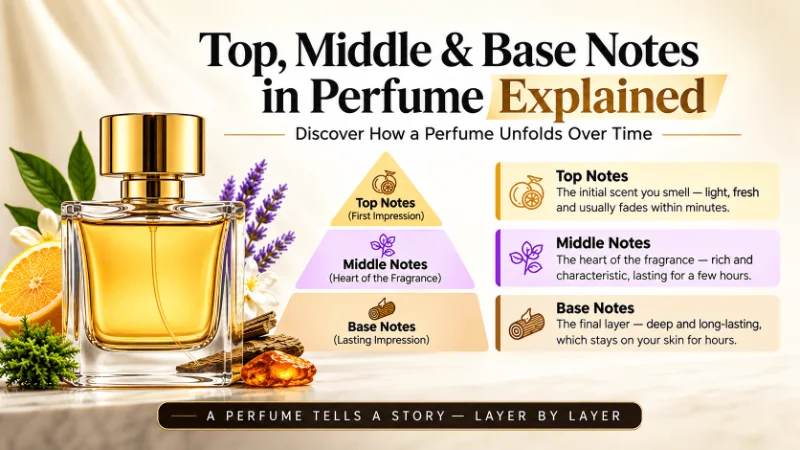
If you have ever searched for perfume notes explained or wondered how perfume notes work, the easiest place to start is with the fragrance pyramid: top notes, middle notes, and base notes.
Understanding these layers can make perfume shopping much easier, especially when you are buying fragrances online. Instead of judging a perfume only by its name or first spray, you can look at its fragrance notes and get a better idea of how the scent may develop.
In this guide, we will explain top, middle, and base notes in perfume, what each layer means, how they differ, and why a fragrance can smell so different several hours after the first spray.
What Are Perfume Notes?
Perfume notes are the individual scent descriptions used to explain the composition and character of a fragrance.
You may see ingredients or scent impressions such as:
- Bergamot
- Lemon
- Lavender
- Rose
- Jasmine
- Cardamom
- Vanilla
- Musk
- Amber
- Sandalwood
- Oud
- Patchouli
These notes are commonly organized into three stages:
Top notes → Middle notes → Base notes
You may also see this represented as a fragrance pyramid.
The pyramid is a simplified way of describing how a fragrance develops. It does not mean that one group completely disappears before the next one begins. Many fragrance materials overlap, and some can remain noticeable throughout several stages of wear.
That is why a perfume can have a fresh opening but eventually become warm, woody, sweet, musky, spicy, or creamy.
What Are Top Notes in Perfume?
Top notes are the scents you typically notice first after applying a perfume.
They create the opening impression and are often responsible for making a fragrance immediately feel fresh, bright, fruity, spicy, aromatic, or energetic.
Common examples of top notes include:
- Bergamot
- Lemon
- Grapefruit
- Orange
- Pear
- Apple
- Mint
- Fresh spices
- Green notes
- Aromatic ingredients
There is no fixed list of ingredients that must be top notes. Different fragrances use different combinations to create their opening.
Why Are Top Notes Important?
Top notes create the first impression of a perfume.
Imagine spraying a fragrance and immediately getting a burst of bergamot, lemon, grapefruit, or mint. That opening can make the perfume feel fresh and lively.
But the first impression is only part of the story.
As the fragrance develops, the opening begins to settle and other parts of the composition become more noticeable.
A good example from the NawmeEssences collection is Giorgio Armani ADG Absolu.
Its listed top notes include sea notes, bergamot, pear, apple, grapefruit, and lemon. The heart moves into lavender, rosemary, and geranium, while the base features woody notes, tonka bean, amberwood, patchouli, and labdanum.
This gives you a good example of how a fragrance can begin with a fresh, citrusy and fruity impression before moving toward a warmer woody base.
How Long Do Top Notes Last?
There is no exact amount of time that applies to every perfume.
The opening can change relatively quickly, but the speed depends on the fragrance itself and how it behaves on your skin.
Factors such as temperature, humidity, skin chemistry, fragrance concentration, and the ingredients used can all affect how a perfume develops.
This is why you should not automatically assume that every fragrance follows a strict timeline such as "top notes last 15 minutes."
Instead, think of top notes as the opening phase of the fragrance.
They are usually more noticeable at the beginning, but the transition into the heart can happen gradually.
What Are Middle Notes in Perfume?
Middle notes, also called heart notes, form the central part of a fragrance.
As the opening settles, the heart of the perfume becomes more noticeable.
Middle notes are often used to give a fragrance its main personality and connect the opening with the deeper base.
Common middle notes include:
- Lavender
- Rose
- Jasmine
- Geranium
- Orange blossom
- Cardamom
- Cinnamon
- Clary sage
- Orris
- Osmanthus
A fragrance does not necessarily need to smell strongly of one particular middle note. Several ingredients may combine to create an overall accord.
For example, Gucci Guilty Elixir lists orange blossom, nutmeg, and pimento seeds at the top. Its heart contains orange blossom, orris, and osmanthus, followed by a base of vanilla, Ambrofix™, benzoin, and patchouli.
The interesting part is that orange blossom appears in both the opening and heart. This shows why fragrance development is not always as simple as three completely separate stages.
Why Are Middle Notes Called Heart Notes?
Middle notes are called heart notes because they form the central character of a fragrance.
The top notes introduce the perfume.
The heart develops its main character.
The base provides the deeper foundation.
So when you see "heart notes" on a perfume page, it is simply another way of referring to the middle section of the fragrance pyramid.
In simple terms:
Middle notes = Heart notes
Both terms describe the same general stage of fragrance development.
What Are Base Notes in Perfume?
Base notes form the deeper foundation of a fragrance and become particularly important during the later stages of wear.
They are often associated with richer scent impressions such as:
- Vanilla
- Musk
- Amber
- Sandalwood
- Cedarwood
- Patchouli
- Oud
- Tonka bean
- Vetiver
- Resins
- Moss
Base notes can give a fragrance warmth, depth, sweetness, creaminess, woodiness, smokiness, or other characteristics depending on the composition.
This is why people often pay close attention to the base when trying to understand the dry down of a perfume.
For example, JPG Ultra Male starts with pear, lavender, mint, bergamot, and lemon. Its heart contains cinnamon, clary sage, and caraway, while the base moves into black vanilla husk, amber, patchouli, and cedar.
Although the opening is fruity, fresh, and aromatic, the later stage has a noticeably sweeter and warmer character.
What Is the Dry Down of a Perfume?
The dry down is how a fragrance smells after it has been on your skin for some time and the initial opening has settled.
This is often when the deeper parts of the composition become more noticeable.
The dry down is one of the most important stages to experience when testing a perfume because it can be very different from the first spray.
You might initially smell citrus and spices, for example, but later notice mostly woods, vanilla, musk, amber, or another deeper accord.
That is why judging a perfume immediately after spraying it is not always the best way to decide whether you like it.
Top Notes vs Middle Notes vs Base Notes
The easiest way to understand the difference is to think about the role each layer plays.
| Layer | What it does | Common examples | Typically noticeable |
|---|---|---|---|
| Top notes | Creates the opening impression | Bergamot, lemon, grapefruit, pear, mint | Mainly at the beginning |
| Middle notes | Develops the central character | Lavender, rose, jasmine, cardamom | As the opening settles |
| Base notes | Provides depth and shapes the dry down | Vanilla, musk, amber, woods, patchouli | Later in the fragrance's development |
These are useful categories, but they should not be treated as rigid rules.
A perfume can contain materials that are noticeable across different stages, and the way a fragrance develops depends on its overall formula rather than one ingredient in isolation.
How a Perfume Changes From Opening to Dry Down
Let's look at another real example.
French Avenue Liquid Brun Limited Edition opens with cardamom, lavender, and citrus.
Its heart contains orange blossom, guaiac wood, and rose.
The base contains vanilla, tonka, amber, and oak moss.
You can see the progression:
Fresh and spicy opening
↓
Floral and woody heart
↓
Sweet, warm and deeper base
This is exactly why reading a fragrance pyramid can be useful before buying a perfume online.
You are not simply looking at a list of ingredients. You are getting clues about how the scent is intended to evolve.
A fragrance database can also help you compare note pyramids and community impressions, but those descriptions are best treated as reference points rather than guarantees of how a perfume will smell on your own skin.
Why Does the Same Perfume Smell Different on Different People?
The same perfume can smell somewhat different from person to person because fragrance interacts with the wearer and environment.
Skin chemistry, temperature, humidity, application amount, and even your surroundings can influence how you experience a fragrance.
This does not necessarily mean the perfume itself has changed.
It means fragrance is experienced in combination with the wearer.
That is another reason it can be useful to test a perfume yourself rather than relying entirely on another person's description or review.
Why You Shouldn't Judge a Perfume From the First Spray
The first spray is only the beginning of the fragrance experience.
A perfume that smells sharp or extremely fresh at first may become smooth and warm later.
Likewise, a fragrance that smells exciting in the opening might develop into a dry down that is not really your style.
When testing a fragrance, try to experience all three stages.
1. Smell the opening
Pay attention to what you notice immediately.
Is it fresh? Citrus-heavy? Fruity? Spicy? Sweet? Aromatic?
2. Let it develop
Do not immediately decide whether you love or hate the perfume.
Give it some time to settle.
3. Check the heart
Notice how the fragrance changes as the initial opening becomes less prominent.
This is when you can start understanding the perfume's central character.
4. Experience the dry down
Come back to the fragrance later and see what remains.
The dry down may reveal a completely different side of the perfume.
5. Make your decision
Judge the fragrance based on the complete wearing experience rather than only the first spray.
How to Read Perfume Notes Before Buying
The note pyramid can help you predict the general character of a perfume before buying it online.
Suppose you generally enjoy fresh fragrances.
You might look for perfumes containing citrus, aquatic, green, aromatic, or fresh spicy notes.
If you prefer warmer fragrances, you may be more interested in combinations featuring vanilla, amber, tonka bean, woods, musk, or spices.
But individual notes do not tell the entire story.
Two perfumes can contain vanilla and amber and still smell completely different.
The proportions, supporting ingredients, accords, concentration, and overall construction all influence the final result.
So use fragrance notes as a guide, not as an exact prediction.
Fragrance Notes and Fragrance Families Are Not the Same Thing
A fragrance note describes an individual scent, while a fragrance family describes the broader style of the perfume.
A note can be something such as:
- Bergamot
- Vanilla
- Rose
- Oud
- Patchouli
A fragrance family describes the broader character of the composition.
For example, a perfume can be classified as:
- Woody
- Oriental Fougere
- Leather
- Aromatic
- Floral
- Fresh
- Amber
NawmeEssences product pages provide both individual fragrance notes and olfactive-family information.
For instance, Giorgio Armani ADG Absolu is listed as Woody Aromatic, while French Avenue Liquid Brun Limited Edition and JPG Ultra Male are listed as Oriental Fougere.
Looking at both the notes and fragrance family gives you a broader understanding of a perfume's personality.
Why Perfume Decants Are Useful When Exploring Fragrance Notes
Perfume decants let you experience a fragrance over multiple wears before committing to a full bottle.
If you have never smelled a particular perfume before, buying a full bottle can be a commitment.
A smaller amount gives you the opportunity to actually wear the fragrance and experience its opening, heart, and dry down before deciding whether you want more.
If you are new to decants, our guide on what a perfume decant is, the different sizes, and how to choose one explains the basics in more detail.
At NawmeEssences, fragrances are offered in multiple sizes, including 3ml, 5ml, 10ml, 15ml, and selected fragrances in 30ml.
The current collection includes 110+ fragrances from 40+ brands, with decants taken from authentic original bottles.
This can be particularly useful for fragrances with complicated note pyramids.
You might like the sound of vanilla, amber, and woods on paper, but the actual combination could be very different from what you imagined.
Wearing a decant lets you find out for yourself.
Exploring Different Fragrance Styles
Once you understand fragrance notes, it becomes easier to compare different perfumes and brands.
For example, if you discover that you enjoy exploring woody, fresh, aquatic, sweet, or aromatic compositions, you can compare several fragrances rather than choosing one at random.
NawmeEssences has dedicated brand collections, including Rasasi perfume decants, where you can compare fragrances such as Hawas for Him, Hawas Black, Hawas Elixir, Hawas Ice, Hawas Kobra, Hawas Malibu, Hawas Tropical, Hawas Lava Gold, and Hawas Thunder.
There is also a dedicated Dior perfume decants collection featuring Dior Homme Sport 2017 and Dior Homme Intense.
The important thing is to use the note structure as a starting point and then experience the fragrance on your own skin.
Do More Base Notes Mean Better Longevity?
No. Having more listed base notes does not automatically mean a perfume will last longer.
It is tempting to look at a fragrance pyramid and assume that a perfume with many base notes will automatically have better longevity.
In reality, performance is more complicated.
The longevity of a perfume can be influenced by its overall formula, concentration, materials, application, skin, environment, and other factors.
A fragrance with a relatively simple-looking base can perform well, while another fragrance with many listed base notes may not last as long on your particular skin.
So do not judge longevity simply by counting the number of notes listed under "Base."
Are Top Notes More Important Than Base Notes?
Neither is inherently more important because top, middle, and base notes serve different purposes.
Top notes help create the initial impression.
Middle notes give the fragrance its central character.
Base notes help shape the deeper dry down.
If you love bright citrus openings, pay attention to the top.
If you care most about the fragrance's main character after the opening settles, focus on the heart.
If you want something warm, rich, woody, musky, or sweet in the later stages, study the base.
Ideally, look at all three.
Frequently Asked Questions
What are top notes in perfume?
Top notes are the scents that typically create the opening impression immediately after a perfume is applied.
What are middle notes in perfume?
Middle notes, also called heart notes, form the central character of a fragrance as the initial opening settles.
What are base notes in perfume?
Base notes provide depth and become especially important during the later stages of a fragrance's development and dry down.
How long do perfume notes last?
There is no universal duration for top, middle, or base notes. How long each stage is noticeable depends on the fragrance, skin chemistry, concentration, environment, and other factors.
Why does perfume smell different after a few hours?
Different fragrance materials become more or less noticeable as the perfume develops, which can make the later dry down smell very different from the opening.
Should I test a perfume before buying a full bottle?
Yes. Testing a fragrance gives you the opportunity to experience its opening, heart, and dry down on your own skin before committing to a full bottle.
Final Thoughts
Understanding top, middle and base notes in perfume makes it much easier to read fragrance descriptions and make more informed choices.
Top notes create the opening impression. Middle or heart notes shape the central character, while base notes provide depth and influence the later dry down.
But fragrance is not as simple as reading three lists.
The real experience comes from how those ingredients work together and how the perfume develops on your skin.
That is why it is worth taking your time when trying something new.
Look at the top, heart, and base notes. Consider the fragrance family. Think about the types of scents you already enjoy. Then give the perfume enough time to develop before making a decision.
And if you are unsure about committing to a full bottle, a decant can be a practical way to experience the fragrance for yourself.
For fragrance lovers in Bangladesh, NawmeEssences offers authentic perfume decants in multiple sizes, with nationwide delivery and pickup options in Dhaka.
Explore the NawmeEssences fragrance collection and discover how different perfumes move from their first spray to their final dry down.